St Vincent de Paul Society
Our Mission is to seek and find those in need, to help them in a spirit of justice and to tackle the causes of poverty where we can.
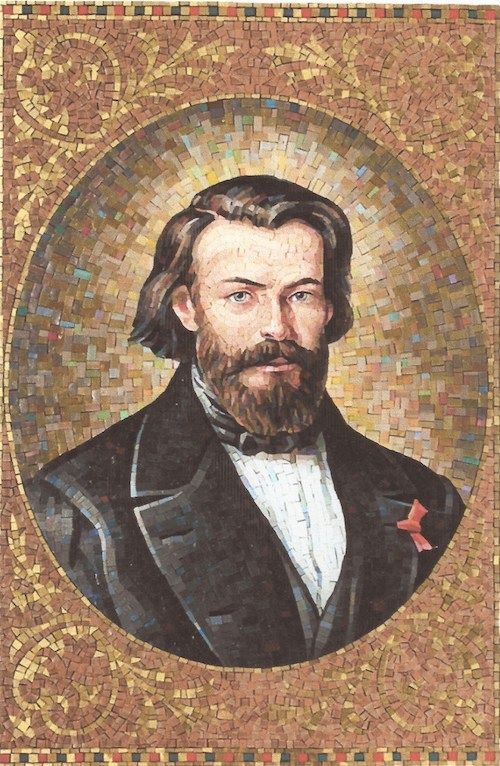
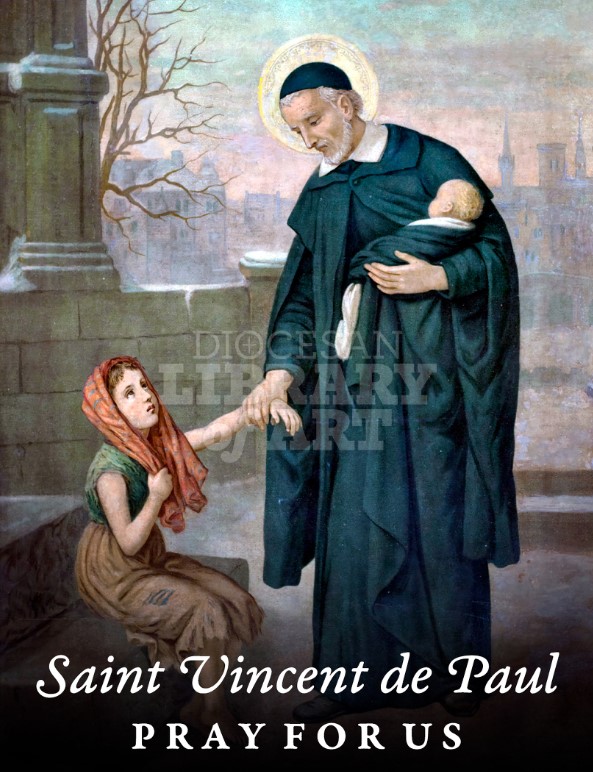
St. Vincent de Paul was born to a poor peasant family in the French village of Pouy on April 24, 1581. His first formal education was provided by the Franciscans. He did so well, he was hired to tutor the children of a nearby wealthy family. He used the monies he earned teaching to continue his formal studies at the University of Toulouse where he studied theology. He was ordained in 1600 and remained in Toulouse for a time. In 1605, while on a ship traveling from Marseilles to Narbonne, he was captured, brought to Tunis and sold as a slave. Two years later he and his master managed to escape and both returned to France.
While there he became a chaplain to the Count of Joigny and was placed in charge of distributing money to the deserving poor. He became pastor of a small parish in Clichy for a short period of time, while also serving as a tutor and spiritual director.
From that point forward he spent his life preaching missions to and providing relief to the poor. He even established hospitals for them. This work became his passion. He later extended his concern and ministry to convicts. The need to evangelize and assist these souls was so great and the demands beyond his own ability to meet that he founded the Ladies of Charity, a lay institute of woman, to help, as well as a religious institute of priests – the Congregation of Priests of the Mission, commonly referred to now as the Vincentians.
This was at a time when there were not many priests in France and what priests there were, were neither well-formed nor faithful to their way of life. Vincent helped reform the clergy and the manner in which they were instructed and prepared for the priesthood.
He did this first through the presentation of retreats and later by helping develop a precursor to our modern day seminaries. At one point his community was directing 53 upper level seminaries. His retreats, open to priests and laymen, were so well attended that it is said he infused a “Christian spirit among more than 20,000 persons in his last 23 years.”
The Vincentians remain with us today with nearly 4,000 members in 86 countries. In addition to his order of Vincentian priests, St. Vincent cofounded the Daughters of Charity along with St. Louise de Marillac. There are more than 18,000 Daughters today serving the needs of the poor in 94 countries. He was eighty years old when he died in Paris on September 27, 1660. He had “become the symbol of the successful reform of the French Church”. St. Vincent is sometimes referred to as “The Apostle of Charity” and “The Father of the Poor”.
His incorrupt heart can be found in the Convent of the Sisters of Charity and his bones have been embedded in a wax effigy of the Saint located at the Church of the Lazarist Mission. Both sites are located in Paris, France.
Two miracles have been attributed to St Vincent – a nun cured of ulcers and a laywoman cured of paralysis. As a result of the first, Pope Benedict XIII beatified him on August 13, 1729. Less than 8 years later (on June 16, 1737) he was canonized by Pope Clement XIII. The Bull of Canonization recognized Vincent for his charity and reform of the clergy, as well as for his early role in opposing Jansenism.
It has been reported that St. Vincent wrote more than 30,000 letters in his lifetime and that nearly 7,000 had been collected in the 18th century. There are at least five collections of his letters in existence today.
The feast day for St. Vincent, the patron of all charitable societies, is September 27.
The society was formed in 1833 by a group of young students in Paris. They were led by Frederic Ozanam, a devout Catholic who was part of a group who discussed change and wrote pamphlets. They were challenged to not just talk but put their faith into action. They accepted this challenge and began undertaking acts of charity, assisting those in need. They took St Vincent, patron saint of the poor, as their patron and so started the Society of St Vincent de Paul (SVP).
The society spread across Europe and into the Americas and then in 1844, one of Frederic’s friends, George Wigley, started the first conference in England at the Sablonniere Hotel in Leicester Square, London. Today the society has around 1000 conferences and 10000 members in England and Wales.
As a Catholic lay organisation, the underpinning foundation of the society is its spirituality. This is displayed through the prayers that start and finish a meeting, praying together at events and festivals and most importantly through pursuing the mission of ‘actively seeking out those in need and offering whatever support one can in a spirit of social justice’. Seeing Christ in the poor and needy and acting with Christ in us, a Vincentian’s actions will clearly demonstrate putting ‘faith into action’. People who need support receive it through the personal contact the SVP offers as well as through the practical and financial resources the society has to offer.
The conference is an individual group based in the parish, but also part of a network of conferences withing a district (essentially a diocesan deanery). The district is then represented at Central Council, the group that oversees and guides the work of the members across the diocese. Brentwood CC is represented at National Council, where the CC president joins with the other 22 CC presidents to review and develop SVP activity at a national level.
The formation of SVP Local society and selection of the members in the committee:
The conference is formed of local members who would select a president, treasurer and secretary to fulfil the administrative requirements of a registered charity (see this paper’s footer).The way a conference works will be determined by the time members can offer, the skills and talents around the table, the context of the parish and the need apparent within the community. The key factor is the members meet regularly to review the work they are doing.
A new conference will agree its own frame of reference – when and where to meet, how to seek out referrals to help, areas of the community to focus on
e.g. those in food poverty; fuel poverty; the lonely, isolated and marginalised; those in care home, hospitals and prisons. The need is out there – the SVP seeks it out and offers support.
We are also keen to learn of innovative ideas or projects that members would like to develop
Training, induction and support are offered to every conference and its members every step of the way. You will have the dedicated support of two Membership Support Officers (MSOs) working for Brentwood Central Council, as well as access to the National Membership Team and all its resources, including substantial funds.
Our new Harlow conference, with volunteers from Harlow’s four Catholic churches: Our Lady of Fatima, The Assumption of our Lady, Saint Thomas More and Holy Cross are very keen to seek your support as we strive to tackle poverty in whatever form it takes in the 21st century. By joining the SVP, you will be a welcome member of the society, adding your own gifts and talents to a team that offers a wealth of experience, resources, support and structures to enable you to make a difference to people in your community. Even an hour a week can make a difference to someone’s life. If you are interested in learning more after reading this, then please contact:
PresidentA030607@svp.org.uk
Jane Pandit – 07417464341
Our founder, Blessed Frederic Ozanam said:
‘Charity must never look to the past but always the future because the number of its past works is very small, but the number of miseries with the present and future is infinite’.
Let’s follow the footsteps of St Vincent De Paul’s for our Harlow Community.
AMEN